
Is this a map?
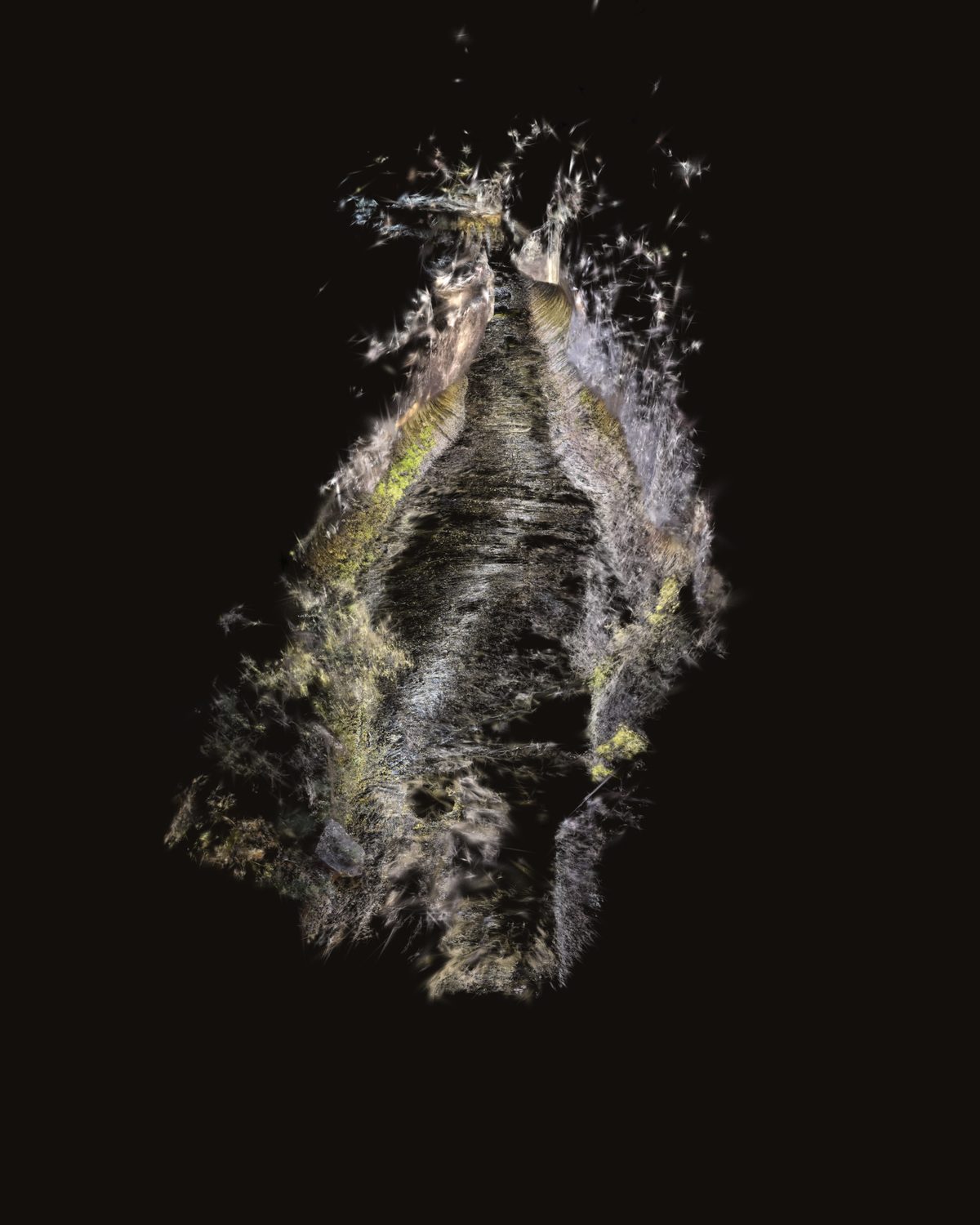
A gaussian splat is a 3D model made of many small, soft blobs. Each blob has a position, a size, a direction and a color. Together, the blobs show a place from any angle.
This splat has some parts of a map. Each rock is in its place, and you can look at it from above. But it has no north and no scale. The GoPro's GPS never got a usable fix in the canyon. The model has its own units, not feet or meters. The only scale is time: the walk took 80 seconds.
Explore the splat
The 3D view opens when you select the button. It downloads 23 MB. The view starts at the same bird's-eye camera as the poster. The gold line is the camera's path.
"Walk the path" moves the camera along the 240 camera positions at the pace of the video. "Show all splats" loads the model before the cleanup, with the floaters. A floater is a splat that hangs in the air and is not on any surface.
From video to splat
- I filmed the walk on November 12, 2026, with a GoPro HERO13 Black. The camera recorded 4K video with its Wide lens and HyperSmooth stabilization.
- I took the first 80 seconds and saved 3 frames each second: 240 frames at 1920 by 1080 pixels.
- COLMAP found the position and direction of the camera for all 240 frames. The mean reprojection error is 0.57 pixels. The Wide lens is a fisheye lens, so COLMAP needed a start value for the focal length.
- Brush trained the splat for 25,000 steps, up to 2 million splats. The training took 68 minutes on the laptop's graphics card.
- Brush kept every eighth frame out of the training. On those 30 frames, the mean peak signal-to-noise ratio is 28.5 dB. A higher value is a closer match to the real frame.
- A Python script cut a box around the walk and removed the floaters. Blender 5.3 rendered the views for the poster.
Cleaning the floaters
The camera saw each place only from eye level, on one pass. Some splats are smears along the camera's line of sight, because the model could not find their depth. From above, these smears look like spikes.
The cleanup removed 38,557 of the 1,024,602 splats in the box. It removed three kinds:
- Very large splats
- Splats with few neighbors
- Large, needle-shaped splats that point toward the nearest camera
Wall splats lie across the line of sight, so most of them stay. The tall upper walls are made of large, spiky splats too. Many of them went with the floaters.
centers, _ = read_cameras(a.images_txt)
_, near = cKDTree(centers).query(pos, workers=-1)
ray = pos - centers[near]
ray /= np.linalg.norm(ray, axis=1, keepdims=True)
axis = long_axis_dirs(
    data,
    np.argmax(
        np.stack([data["scale_0"], data["scale_1"], data["scale_2"]], axis=1),
        axis=1,
    ),
)
aligned = np.abs(np.sum(axis * ray, axis=1)) >= a.ray_cos
is_needle &= alignedclean_splat.py. For each splat, the test finds the nearest camera and the direction from that camera to the splat. A needle that points along that direction is a smear. a.ray_cos is 0.9, about 26 degrees. The excerpt passes the ruff linter and uses its code format.Method
- The levelled frame uses the mean "up" direction of the 240 camera positions. The camera was tilted down, so the level is approximate.
- The model has no north. The GoPro recorded GPS samples, but none in the 80 seconds had a 3D fix. The dilution of precision was 77 or higher, so the positions are not usable.
- The model has no scale in feet or meters. The poster's times come from the frame count, at 3 frames each second.
- The notes at each time describe the video frame at that time.
- The 3D view uses the SPZ format. The cleaned splat keeps all of its color data. The full splat keeps only the first band of the view-dependent color, to keep the file smaller.
Limits
- One pass at eye level does not show the floor or the walls well from above. More training did not help the bird's-eye view.
- The frames were 1920 by 1080 pixels. A larger frame size can keep more of the 4K detail.
- The 3D view needs WebGL 2. It can be slow on old phones.
Data and credit
The video is my own. COLMAP found the camera positions. Brush trained the splat. Spark, from World Labs, draws the splat in the browser with three.js. SplatTransform, from PlayCanvas, made the SPZ files.